
Babywearing can make newborn life a little easier. It keeps your baby close while giving you more freedom to move, eat, walk, or simply use both hands.
Still, wearing a newborn safely requires the right positioning.
The easiest rule to remember is T.I.C.K.S.: Tight, In view, Close enough to kiss, Keep chin off chest, and Supported back.
If you are new to babywearing, this guide will help you check your baby’s position, choose a carrier, and feel more confident getting started.
You don’t have to do postpartum alone
Our doulas provide practical, compassionate support to help make everyday life with your new baby feel a little easier.
The T.I.C.K.S. Rule for Safe Babywearing
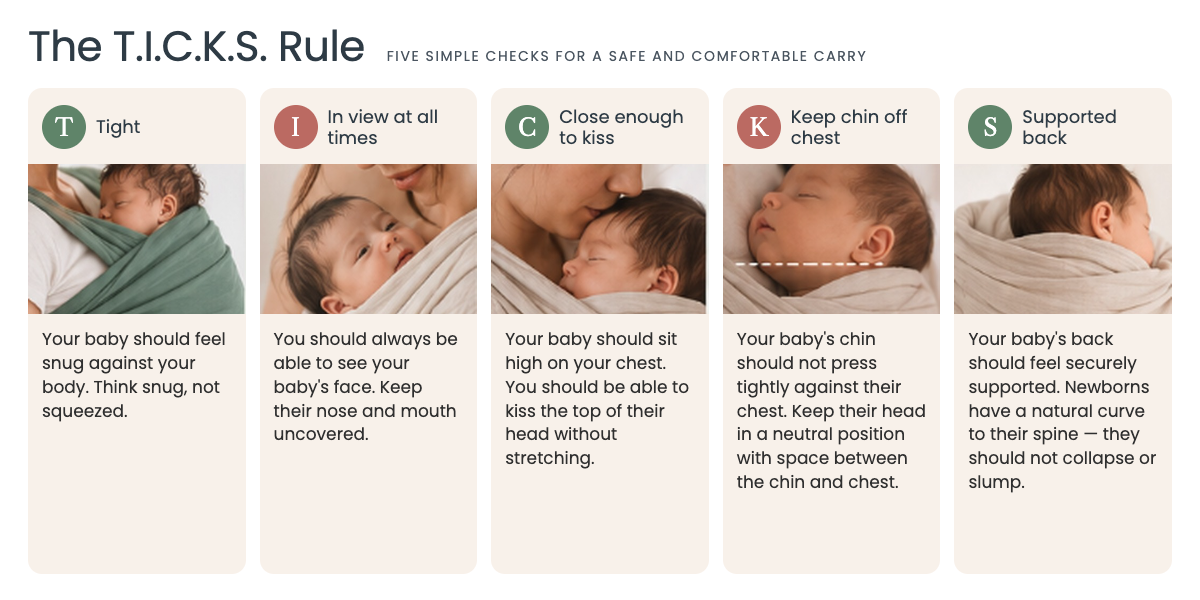
Before you start walking around, run through these five checks.
T — Tight
Your baby should feel snug against your body.
If the carrier is too loose, your newborn may slump or sink lower. A secure fit helps support their body and keeps them in a better breathing position.
Think snug, not squeezed.
I — In View at All Times
You should always be able to see your baby’s face by looking down.
Make sure no fabric covers their nose or mouth. You should not need to move the carrier aside to check their breathing.
This is especially important for newborns because they cannot easily reposition themselves.
C — Close Enough to Kiss
Your baby should sit high on your chest.
When you tilt your head down, you should be able to kiss the top of their head without stretching.
If your baby feels very low on your body, tighten or reposition the carrier.
K — Keep Chin Off Chest
Your newborn’s chin should not press tightly against their chest.
A deeply curled or slumped position can restrict a young baby’s airway.
Check that your baby’s head stays in a neutral position and that there is space between their chin and chest.
S — Supported Back
Your baby’s back should feel securely supported.
Newborns naturally have a gently curved spine, so they do not need to sit completely straight. However, they should not collapse or slump inside the carrier.
A properly tightened carrier should hold them comfortably against your body.
What Is the Best Position for a Newborn in a Carrier?
For most newborns, think:
High, upright, inward-facing, and supported.
Your baby’s chest and tummy should face your body. Their head should stay close enough to kiss, while their nose and mouth remain clear.
Because newborns have limited head and neck control, your carrier must provide appropriate support.
Always check the manufacturer’s instructions too. Not every carrier works from birth, and some require a newborn setting or minimum weight.
What About Baby’s Hips and Legs?
You may hear babywearing educators talk about the “M-position.”
In this position:
- Baby’s knees stay bent.
- Their knees sit slightly higher than their bottom.
- Their thighs receive support.
- Their hips can spread naturally.
From the front, their legs loosely resemble the letter M.
You do not need to force your baby’s legs into a wide position. Instead, aim for comfortable, natural hip and leg support.
Should a Newborn Face In or Face Out?
Newborns should generally face inward toward the caregiver.
Inward-facing babywearing makes it easier to support your baby’s head, watch their breathing, and keep them securely positioned.
Outward-facing positions require more head and trunk control. They also depend on your carrier’s specific instructions.
There is no need to rush this milestone.
Which Baby Carrier Is Best for a Newborn?
The best carrier is one that fits your baby, your body, and your routine.
Common options include:
Stretchy Wraps
Stretchy wraps are soft and cozy for young babies. They can create a close fit, although learning how to tie them takes practice.
Ring Slings
Ring slings are convenient for quick carries. However, careful positioning is especially important with newborns. Keep your baby upright, visible, and supported rather than curled deeply inside the sling.
Soft Structured Carriers
These carriers use shoulder straps, a waistband, and buckles. Many parents find them easier to put on than wraps.
Some work from birth, while others require an insert or minimum baby weight.
Woven Wraps and Meh Dais
These carriers offer plenty of flexibility and support but may take more practice to use confidently.
Whatever style you choose, always follow the manufacturer’s newborn instructions.
Find the support that feels right for your family
Every postpartum experience is different. Our doulas meet you where you are with personalized care for you, your baby, and your family.
Your 30-Second Babywearing Safety Check
Before you start moving, ask:
- Can I see my baby’s entire face?
- Is their nose and mouth uncovered?
- Can I easily kiss their head?
- Is their chin away from their chest?
- Does their back feel supported?
- Is the carrier snug?
- Are their hips and legs comfortably positioned?
- Are all buckles, straps, rings, and seams secure?
It is also smart to check your baby again as you move. Their position can shift while walking, bending, or feeding.
Can a Newborn Sleep in a Baby Carrier?
Newborns often fall asleep while being worn. The warmth, movement, and closeness can be very soothing.
However, a baby carrier is not a replacement for a safe sleep space.
The American Academy of Pediatrics (AAP) recommends moving a sleeping baby to a firm, flat sleep surface on their back as soon as practical.
While your baby remains in the carrier, continue checking their face, head position, and airway.
What If Babywearing Feels Awkward?
It often does at first.
Try practicing when your baby is calm and fed. A mirror can help you check their position. You can also practice over a bed or another low, soft surface while building confidence.
If the carrier feels uncomfortable, your baby seems too low, or you are unsure about positioning, ask for help.
A postpartum doula or babywearing educator can help you adjust your carrier and practice safely.
At Doulas by the Bay, we help families navigate the everyday questions that come with bringing a baby home. From babywearing and newborn care to feeding and postpartum recovery, compassionate support can make the learning curve feel much more manageable.
We also offer our educational program
If you want personalized guidance during the newborn stage, we’re here to support your family with practical, evidence-based postpartum care.
A little support can make a big difference
From newborn care and feeding to rest, routines, and reassurance, our doulas are here to support you through the postpartum transition.
This article is for educational purposes only and does not replace medical advice or your carrier manufacturer’s instructions. Contact your baby’s healthcare provider for guidance specific to your baby.
References
- American Academy of Pediatrics. Baby Carriers: Backpacks, Front Packs & Slings.
- American Academy of Pediatrics. How to Keep Your Sleeping Baby Safe.
- U.S. Consumer Product Safety Commission. Infant sling carrier safety guidance.
- International Hip Dysplasia Institute. Babywearing and hip positioning guidance.